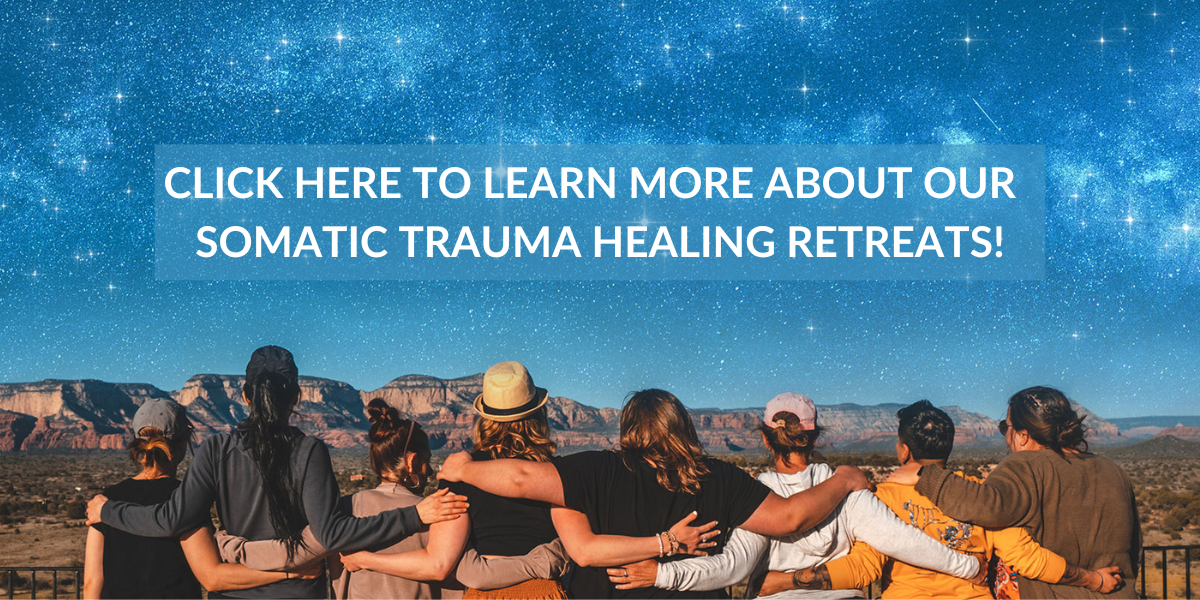
Can a Trauma Retreat Help When Therapy Isn’t Enough? A Somatic Approach to Healing
Published: July 21, 2026
A trauma retreat can be a powerful next step for people who have spent years in therapy, personal growth, and self-discovery—but still feel like something inside them has not fully healed.
Maybe you understand your story.
Maybe you can explain exactly where your wounds come from.
Maybe you know your attachment patterns, your childhood experiences, your triggers, and the reasons you learned to protect yourself.
You have done the work.
You have sat in therapy sessions.
You have read the books.
You have practiced mindfulness.
You have reflected, journaled, processed, and tried to become more aware of yourself.
And yet...
Something still feels stuck.
You may still find yourself reacting in ways you thought you had healed.
You may still feel anxious in relationships even when you know you are loved.
You may still struggle to trust yourself, express your needs, or feel fully at home in your own body.
And perhaps the most frustrating part is this:
You know better.
But you do not always feel different.
This is one of the most common reasons people begin searching for a trauma healing retreat.
Not because therapy has failed.
Not because they have done something wrong.
But because they are ready for healing to move beyond understanding and into lived experience.
Because trauma healing is not only about knowing your past.
It is about creating a new relationship with yourself in the present.
Why Understanding Your Trauma Isn’t Enough to Create Lasting Change
One of the most painful parts of long-term healing work is realizing that awareness does not always equal transformation.
You can have incredible insight and still feel overwhelmed.
You can understand your reactions and still struggle to respond differently.
You can know intellectually that you are safe while another part of you remains braced for something to go wrong.
This can feel confusing.
You might think:
“Why am I still triggered if I know where this comes from?”
“Why do I still feel shame when I know I am worthy?”
“Why do I still fear abandonment when I understand my attachment wounds?”
The answer is not that you need to try harder.
Often, the missing piece is that healing happens at more than one level.
The mind understands through insight.
The body learns through experience.
The nervous system changes through repeated experiences of safety, connection, and choice.
For example:
You can understand that you are lovable.
But there is a different kind of healing that happens when you reveal something vulnerable and someone responds with warmth instead of rejection.
You can understand that your emotions are valid.
But there is a different kind of healing that happens when you express those emotions and discover you are still accepted.
You can understand that you no longer have to shrink yourself.
But there is a different kind of healing that happens when you take up space and realize connection remains.
This is where immersive trauma healing experiences can offer something unique.
Why Trauma Patterns Can Continue After Years of Therapy and Healing Work
Many people become discouraged when old patterns continue after years of therapy or personal growth.
They begin wondering:
“Shouldn’t I be past this by now?”
But protective patterns are not simply thoughts that can be deleted once we understand them.
They are often learned responses that developed during times when we needed protection, connection, or safety.
For example:
- Someone who learned that conflict threatened connection may automatically avoid difficult conversations.
- Someone who experienced unpredictable relationships may become highly sensitive to changes in another person’s mood.
- Someone who learned that being fully themselves led to rejection may minimize their emotions, needs, or desires.
These responses are not signs that someone is broken.
They are signs that the nervous system adapted.
The challenge is that a strategy that once helped us survive may no longer support the life and relationships we want to create.
Healing involves creating enough safety and awareness that we can begin responding from the present instead of automatically reacting from the past.
Instead of asking:
“What is wrong with me?”
We can begin asking:
“What was this part of me trying to protect?”
“What does this response need now?”
“What would it feel like to approach myself with compassion instead of criticism?”
What Therapy Provides and What a Trauma Retreat Adds
Therapy can be a deeply valuable and transformative part of healing.
A skilled therapist can help you understand your experiences, process emotions, develop insight, and create healthier ways of relating to yourself and others.
For many people, therapy is life-changing.
But some people eventually reach a point where they realize they are ready for another layer of healing.
A trauma retreat does not replace therapy.
Instead, it creates a different kind of opportunity.
Therapy often provides space to:
- Reflect on your experiences
- Understand your patterns
- Process emotions
- Develop self-awareness
An immersive trauma retreat creates opportunities to:
- Practice new ways of relating while they are happening
- Experience safety and connection in real time
- Express yourself while remaining connected to others
- Receive support while being vulnerable
- Build trust with yourself through lived experience
There is a difference between understanding that you are worthy and having the experience of being fully seen and accepted.
There is a difference between learning about boundaries and practicing expressing your needs in relationship.
There is a difference between discussing vulnerability and allowing yourself to be vulnerable while discovering you are still safe.
Healing often happens when insight becomes experience.
How Somatic Trauma Healing Helps When You Feel Stuck
A somatic trauma retreat includes the body as part of the healing process.
The word somatic means relating to the body.
A somatic approach recognizes that emotional experiences are connected with physical sensations, nervous system responses, movement patterns, and the ways we relate to ourselves and the world.
When we experience overwhelming stress or trauma, our nervous system can adapt by developing protective responses that influence how we respond to ourselves, others, and our environment.
These responses may show up as:
- Feeling constantly on alert
- Difficulty relaxing or slowing down
- Overthinking and rumination
- Feeling disconnected from yourself
- Shutting down emotionally
- Difficulty trusting yourself
- Feeling unsafe even when life is going well
A somatic approach does not mean forcing yourself to release emotions or pushing past your limits.
It means learning to notice what is happening inside you with curiosity rather than judgment.
It means creating new experiences where your nervous system can begin learning:
“I can feel this emotion and stay present.”
“I can express myself and remain connected.”
“I can experience discomfort without abandoning myself.”
Why Relational Experiences Matter in Trauma Healing
One of the most important parts of trauma healing is often overlooked:
Many emotional wounds develop within relationships—and many of those wounds need new relational experiences to transform.
Humans are relational beings.
From the beginning of our lives, we learn through connection.
We learn whether our emotions are welcome.
We learn whether we can express our needs.
We learn whether we can be fully ourselves and still belong.
Research in attachment theory, interpersonal neurobiology, and social neuroscience has explored how relationships influence emotional regulation, resilience, and our sense of self.
The American Psychological Association describes attachment as the emotional bond that influences how we relate to others, experience closeness, and respond within relationships.
According to Polyvagal Theory, developed by Dr. Stephen Porges, the nervous system plays an important role in how we detect cues of safety and threat in our environment and relationships. While specific aspects of Polyvagal Theory continue to be discussed within the scientific community, broader research supports the importance of supportive relationships, social connection, and emotional safety in human wellbeing.
This matters because many healing journeys focus primarily on what happens internally.
But some of the deepest shifts happen when we experience ourselves differently with another person.
When we share something vulnerable and are met with care.
When we express an emotion and are not rejected.
When we allow ourselves to be fully seen and discover:
- “I can be myself and still be accepted.”
- “I can express my emotions and still be loved.”
- “I can take up space without being too much.”
- “I can let people see me without needing to hide.”
How Group Experiences Support Healing at a Trauma Retreat
A powerful trauma retreat is not only about what you learn.
It is also about what you experience.
At a somatic trauma retreat, where relational experiences are prioritized in the healing process, the group itself becomes part of the healing environment.
Participants have the opportunity to practice:
- Being witnessed without needing to perform, explain, or hide parts of themselves
- Expressing emotions while staying connected to others
- Receiving support without feeling like a burden
- Taking up space without apologizing
- Experiencing belonging without needing to change who they are
For many people, this creates a new experience that directly challenges old beliefs.
The belief may have been:
“If people really see me, they will leave.”
The new experience becomes:
“When people really see me, I can still be loved.”
This is relational healing.
Not simply learning about connection, but experiencing it.
What Trauma Retreat Healing Can Look Like After Years of Therapy
Many people arrive at trauma retreats carrying something heavier than their symptoms.
They carry the fear that maybe they are the exception.
Maybe they are too damaged.
Maybe they are too complicated.
Maybe healing is possible for other people—but not for them.
That was Jen’s experience.
Jen had spent years in therapy trying to heal. She had done the work, explored her experiences, and searched for answers.
But instead of feeling free, she continued carrying the belief that something inside her was fundamentally wrong.
She had even been told by multiple therapists that she was “unhealable.”
By the time she came to retreat, she was not looking for another explanation of why she struggled.
She was longing for a different experience.
Throughout the retreat, Jen began experiencing something she had not been able to access through understanding alone.
She experienced what it felt like to be surrounded by people who saw her—not as broken, but as human.
She finally had a safe space to express her emotions without needing to minimize them.
She was surrounded by the right people to be supported without needing to earn it.
She experienced connection without having to perform, prove, or hide.
And something began to shift.
Not because someone convinced her that she was worthy.
But because she finally experienced what it felt like to be treated as if she already was.
“I was told by multiple therapists I was ‘unhealable’ and spent years in therapy without change. For the first time, at Orit’s retreats, I released trauma and experienced real love and acceptance with a group of strangers. It left me speechless.
Now I trust myself with my emotions and feel safe being fully me. I’ve already done three retreats, and I’ll be back again.”
— Jen
How an Immersive Trauma Retreat Helps Turn Insight Into Experience
A weekly therapy session can create meaningful change.
But an immersive trauma retreat offers a different environment.
For several days, healing becomes the focus.
You step outside of your normal routines, responsibilities, and roles.
You have space to slow down.
Space to feel.
Space to move.
Space to connect.
Space to practice new ways of relating to yourself and others.
Instead of experiencing safety or connection as something you only discuss, you have the opportunity to repeatedly practice it.
This repetition matters.
The nervous system learns through experience.
A retreat creates an intentional environment where new experiences of trust, self-expression, and connection can begin to take root.
Why an Immersive Trauma Retreat Can Create Change That Insight Alone Cannot
A major reason people feel stuck after years of healing work is that they often return to the same environments where their protective patterns were formed.
The same routines.
The same responsibilities.
The same relationships.
The same expectations of who they believe they need to be.
A trauma retreat creates a meaningful interruption.
Not an escape from life.
A space to experience yourself outside of your usual roles and survival strategies.
You are no longer only the person who takes care of everyone else.
The person who holds everything together.
The person who avoids conflict.
The person who minimizes their own needs.
You have space to explore:
“What happens when I stop performing?”
“What happens when I allow myself to be supported?”
“What happens when I let people truly see me?”
In an immersive healing environment, transformation is not something you think about for one hour each week.
It becomes something you practice throughout the day.
You practice expressing yourself.
You practice receiving support.
You practice staying connected to yourself while connecting with others.
You practice experiencing emotions without immediately judging, fixing, or pushing them away.
These repeated experiences matter because lasting change often happens through what we repeatedly experience—not only what we understand intellectually.
What Is the Difference Between a Trauma Retreat and Therapy?
Therapy can be incredibly valuable.
It can help you understand your history, process painful experiences, develop insight, and create meaningful change.
A trauma retreat does not replace therapy.
Instead, it offers a different kind of healing environment.
Therapy often creates space for reflection and processing.
A trauma retreat creates space for immersion and practice.
Instead of only talking about safety, you have opportunities to experience safety.
Instead of only exploring relationships, you practice connection in real time.
Instead of only understanding your patterns, you begin experimenting with new ways of being.
This is especially meaningful for people who already understand themselves deeply but still feel disconnected from lasting change.
Sometimes the missing piece is not more insight.
Sometimes it is a new experience.
Why Orit Krug’s Trauma Retreats Use Somatic and Relational Healing
Orit Krug’s approach is rooted in her professional training as a Board-Certified Dance/Movement Therapist (BC-DMT) and Licensed Creative Arts Therapist (LCAT), along with more than 15 years of experience supporting emotional healing through the body.
Her retreats integrate movement, embodiment practices, nervous system awareness, emotional processing, and relational healing to support people who have already done significant inner work and are ready for a deeper experience.
Rather than focusing only on why you feel the way you feel, the work invites you to explore:
- How your body responds to emotions
- How protective patterns developed
- How to create more internal safety
- How to experience connection without abandoning yourself
- How to build greater trust in yourself
The goal is not to become someone new.
The goal is to reconnect with the parts of yourself that may have been hidden beneath years of protection and survival.
Is a Trauma Healing Retreat Right for You?
A trauma retreat may be a meaningful next step if you:
- Have spent years in therapy but still feel emotionally stuck
- Understand your trauma intellectually but want deeper embodied change
- Feel disconnected from your body, emotions, or intuition
- Notice repeating relationship patterns you want to transform
- Long to feel safer expressing your authentic self
- Want healing that includes both personal insight and relational experience
You do not need to be at your breaking point to seek deeper healing.
Sometimes the next step is not learning more about yourself.
Sometimes the next step is experiencing yourself differently.
Frequently Asked Questions About Trauma Healing Retreats
Can a trauma retreat replace therapy?
No. A trauma retreat is not a replacement for psychotherapy or mental health treatment.
It can complement therapy by providing immersive opportunities for embodiment, reflection, nervous system support, and relational healing.
Why do I still feel stuck after years of therapy?
Many people discover that understanding their patterns does not automatically change how they feel internally.
A trauma retreat can offer opportunities to practice new experiences of safety, connection, and self-trust.
How does a trauma retreat help when therapy is not enough?
A trauma retreat provides dedicated time away from everyday roles and responsibilities, allowing participants to focus deeply on healing through the body, emotions, and relationships.
What happens at a somatic trauma retreat?
Somatic trauma retreats may include movement practices, nervous system regulation exercises, mindfulness, emotional processing, reflection, and supportive group experiences.
Explore Somatic Trauma Healing Retreats
If you have spent years understanding yourself but still feel something is unresolved, you may be ready for a different kind of healing experience.
Not more information.
Not more self-criticism.
Not another attempt to fix yourself.
A chance to experience something new:
Safety.
Connection.
Self-trust.
Belonging.
Explore Orit Krug’s upcoming somatic trauma retreats →